
Efficiency that transforms
The pomegranate juice market continues to stand out within the premium segment of fruit ingredients, driven by health-focused demand and a strong functional positioning. However, 2025 has been characterised by tight supply, high price stability and significant climatic challenges.
Based on the July, August, October and November editions of Juice Market 2025, the following trends define the current landscape.
Limited Supply: The Defining Challenge of 2025
Throughout the year, processors reported reduced availability of pomegranate concentrate, especially for high-grade qualities such as 65–68 brix. Contributing factors include:
- Heatwaves and extreme temperatures
- Water scarcity in producing regions
- Smaller fruit sizes
- Lower extraction yields
- Variability in colour and organoleptic profile
This persistent shortage of raw material keeps availability tight for industrial buyers.
Mak Food Company, based in Spain, works within this context by prioritising reliable sourcing, sustainability and flexible supply models, reinforcing its position as a specialist in high-value concentrates.
High and Stable Prices: A Consolidated Premium Segment
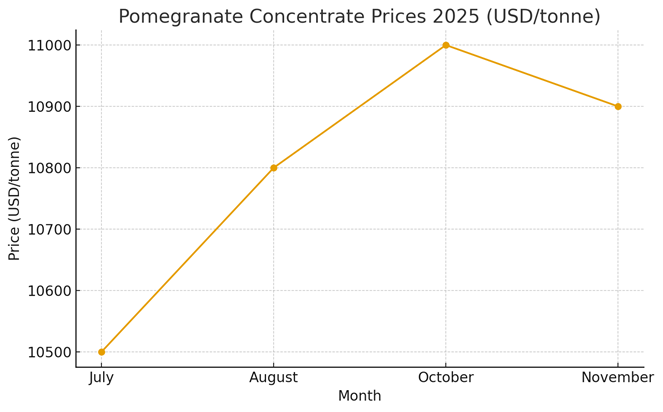
Despite the supply constraints, prices have remained remarkably stable across the second half of 2025.
Pomegranate concentrate 66–68 brix
USD 10,000 – 11,000 per tonne FOB
This range was consistently reported in July, August, October and November 2025, highlighting a firm and resilient premium market.
Demand Resilience in High-Value Applications
Even with elevated prices, demand for pomegranate juice concentrate remains solid, particularly in segments where the fruit’s attributes have the greatest impact:
- Functional beverages
- Wellness shots
- Premium juice blends
- RTD health-oriented products
The category benefits from pomegranate’s strong association with antioxidants, polyphenols and natural wellness.
Mak Food Company incorporates pomegranate into its portfolio of high-quality fruit concentrates, offering a solution aligned with the increasing demand for functional, clean-label ingredients.
Europe: A Key Market Under Pressure
Europe remains a major destination for pomegranate concentrations, yet the region is navigating:
- Retail pressure to control prices
- A general slowdown in juice consumption
- Higher logistics and storage costs
- Limited spot availability from producers
In this context, Mak’s model — centred on efficient processing, sustainable practices and multiple packaging formats (from small packs to 25,000 kg) — aligns well with the logistical needs of European manufacturers.
Risk Factors to Watch for 2026
Several elements could continue shaping the category:
- Weather instability and harvest unpredictability
- Scarcity in spot markets
- Inflation in transport and energy costs
- Tight processing capacity across major producing regions
These risks suggest a market that will likely remain premium and supply-constrained.
Outlook 2026: Stability in a Premium Niche
Forecasts indicate that:
- Price levels are likely to stay firm
- Demand will remain strongest in functional and high-value beverage applications
- Blends may grow in popularity to optimise cost and colour
- Certifications and sustainable sourcing will gain influence
Mak’s focus on sustainability, traceability and operational efficiency positions it well within this framework, offering manufacturers high-quality fruit concentrates suited to evolving market needs.
Conclusion: A Strategic Ingredient in a Tight Market
The pomegranate juice category combines scarcity, high value and strong functional properties. Understanding its dynamics — from orchard limitations to price stability — is essential for ingredient buyers and beverage manufacturers.
Mak Food Company exemplifies how a processor can operate effectively in this environment:
with premium concentrates, responsible sourcing, flexible logistics and a commitment to efficiency.
Efficiency that transforms is more than a claim — it reflects how Mak navigates and contributes to a market defined by both constraints and opportunity.